Scorpius versus Saggitarius

Scorpius versus Saggitarius

Tuesday, March 27, 2012

APOD 3.8

Solar Flare in the Gamma-ray Sky
2012 March 15
Chapters 21 and 22 of our textbooks deals with extrasolar objects identified by gamma radiation from space: pulsars, black holes, and supernova remnants; however, on March sixth and seventh the sun's solar energy soared and dominated our gamma readings. Gamma rays are the highest energy form of light therefore a gamma ray sky will look drastically different than what we perceive in the visible light spectrum. At one hundred times brighter than the Vela Pulsar, an object that is consistently the brightest source of gamma rays in the sky, a X-class solar flare was captured by the Fermi Space Telescope. Telescopes such as these examine the highest wavelengths: radio, X-ray, and Gamma; additionally, X-class flare are the most massive class of solar flare possible. Below is the imaged captured by the Fermi Space Telescope.
While we know so much about the sun due to its close proximity and its radiation of light across all spectrums; pulsars are harder to study for the exact opposite reasons, they are far and faint. Another contributing factor is the way pulsars spin, if the beam of emission is  not pointed towards Earth we cannot detect it's gamma rays. What is most interesting is the rate at which their neutron stars, located at the center of the pulsar, rotate. One the size of Manhattan can rotate hundreds of times in a second. The fastest recorded rotation rate of a pulsar is 736 rotations per second. Numbers like that... are dizzying.

Wednesday, March 21, 2012

Supernovae/ Supernovas

3/21/12
Supernovae at different times in their "life".
Crab Nebula (M1) located in Taurus at SN 1572 and SN 1604. It can be observed by the naked eye in the Milky Way galaxy and is around one thousand years old. The Crab Nebula is a supernova remnant.
"The nebula was observed by John Bevis in 1731; it corresponds to a bright supernova recorded by Arab, Chinese and Japanese astronomers in 1054. At X-ray and gamma-ray energies above 30 keV, the Crab is generally the strongest persistent source in the sky".


"After" and "Before" pictures of Supernova 1987A


Supernova 1987 is located in the Large Magellanic Cloud. The picture taken below came from the Hubble Space Telescope and uses far-reaching ultraviolet technology. While we saw the light in 1987 the actual explosion occurred some 160,000 years ago.


Supernova SN 2006bc is located in the galaxy NGC 2397, 60 million light years away from Earth, a classical spiral galaxy very similar to our own, which allowed Hubble to study individual stars inside it in great detail. The constellation that it occupies is Carina the Sail and the name we know it by is Eta Carinae. The age is undetermined but it is believed that Eta Carinae will collapse into a black hole within a million years.


Supernova remnant Cassiopeia A is located in the constellation Cassiopeia, which is also in the Milky Way galaxy. The colored X-ray image showing silicon ion concentration in the supernova remnant Cassiopeia A (Cas A). These colors represent the intensity of X-ray emission, from green (lowest) through magenta to yellow (highest). Cas A is the remains of a star which exploded as a supernova around 300 years ago. It blew up around the year 1667; the celestial object was not noticed till August. 16, 1680 by John Flamsteed.

Sunday, March 18, 2012

APOD 3.6

2012 February 22  
A Sailing Stone in Death Valley 
Death Valley is a desert valley located in California and oddly enough has a very low fatality rate. After doing some research, I found Yellowstone National Park has had 14 more fatalities than Death Valley. In fact, its name stems from the lack of vegetation and life that the oppressive heat causes.


The dried lake-bed known as Racetrack Playa is a completely flat salt flat that features a few large stones (featured above). The "sail stones" are not easily movable by normal, human means; however, Earth uses its natural forces to scoot these 300 kilogram rocks along. Through a combination of wind and a slippery surface, caused by recent rainfall, can shift these rocks on a scale that no human eye can discern. Much like man celestial objects in our nighttime sky, these rocks need additional, non-human equipment to track their motion.


APOD 3.7

Jupiter Unplugged
2012 March 2
I never thought there could a career known as an astronomical artist, but Fred Burgeot and his rendition of Jupiter's turbulent clouds has changed my preconceived notions. I was under the impression that art skills and astronomy were obsolete with modern day imaging: photographs, 3-D models, animations, etc. It is interesting to see a modern day astronomer draw, with better details, the same celestial objects Galileo looked at in 1610; Fred even managed to sketch the original Galilean moons! It is comforting to know that there are some objects, that age so slowly, the passage of time does not change our observations about them.

Galileo and Fred Burgeot comparison ^

Saturday, March 17, 2012

Quarter 3/ Observation #3

Saint Patrick's Night (March.17,2012)
Waning Crescent Moon Tonight
9:00 P.M.-11 P.M.
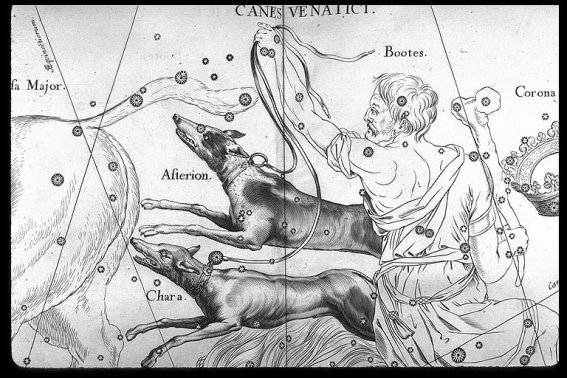
In the western sky Jupiter and Venus can be seen with Venus climbing higher and Jupiter falling into the horizon; Mars and Saturn( the latter not visible with the naked eye) is in the eastern sky. The entire sky has a mixture of spring and winter constellations which coincides nicely with the warmer nights. I can see Gemini's Castor and Pollux along with the constellation Cancer; these are the only zodiacal constellations I happened to notice. Finally I could discern the area where Canes Venatici would be along with the parts of the ship: keel, stern, compass, and sail.
2 Hours Observed


Sunday, February 26, 2012

Enjar Hertzsprung

Fuerst 1
Richard Fuerst
Mr. Percival
DE Astronomy
2 March 2012
Ejnar Hertzsprung
            Born on October 8th, 1873, a young Dane would be lead away from the field of astronomy; ironically, he would become one of our greatest contributors to the study of stars, this astronomer was Ejnar Hertzsprung. Ejnar Hertzsprung's father, Severin Hertzsprung, had a graduate degree in astronomy but, for financial reasons, accepted a position in the Department of Finances; he advised his son against the financial insecurity of astronomy, therefore Ejnar opted for chemical engineering as a career path. After graduating from the Polytechnical Institute in Copenhagen in 1898 and spent several years as a chemist before he began to study photochemistry in Wilhelm Ostwald's laboratory. During this period he began talking with astronomer Karl Schwarzschild, and within a few years he joined Schwarzschild as senior staff astronomer at the observatory in Potsdam. By 1919 Hertzsprung was the associate director and associate professor of the University of Leiden, and in 1935 he became its director. Hertzsprung retired in 1944 and returned to Denmark, continuing his research until 1966. He died at 94, thirteen days after his birthday.

           
Fuerst 2
            What made Ejnar Hertzsprung so important to astronomy? Two words: Hertzsprung-Russell diagram; Hertzsprung work with stars and luminosity yielded the means for determining stellar distances, galactic structures, and distances to other galactic systems. His unique background consisting of photometry and chemistry made him more qualified in the emerging field of spectrometry. Before Hertzsprung contributed to our understanding of the physical nature of stars, we only knew the radial velocities and the spectras of different stars. It was not until 1905 and 1907 that he showed the relationship between the sharp/deep features of absorption lines and a star's luminosity in his papers called Zur Strahlung der Sterne. We could now measure intrinsic brightness with stellar spectra! The Hertzsprung-Russell diagram relates the luminosity of stars with their temperature, so high temperature / luminosity stars occupy the top right and low temperature/ luminosity rest in the bottom left areas of the scatter plot. Most stars are main sequence stars and have a direct relationship between their temperature and absolute magnitude. There are some stars, which Hertzsprung alludes to in his papers, that do not necessary follow the temperature/luminosity relationship. For example, red giants are very luminous yet lack the higher temperatures of their blue giant counterparts. Hertzsprung research was the cornerstone of the later illustration that became the Hertzsprung-Russell diagram. One diagram he did create was one for the Pleiades star cluster in 1906; he also inferred that stars of the same cluster would be approximately the same distance away from Earth. He concluded that this distance was negligible! He also constructed a diagram for the Hyades using this principle. Hertzsprung came up with the method of obtaining distances for binary-star systems and different photographic methods to help gather data on stars. Altogether he made 36,000 estimates of the brightness of variable stars. Finally his determination of the distance to the Small
Fuerst 3
Magellanic Cloud ,  the furthest distance determined for that time (10,000 parsecs), earned him the gold medal of the Royal Astronomy Society.