Scorpius versus Saggitarius

Scorpius versus Saggitarius
Showing posts with label Stargaze. Show all posts

Monday, February 13, 2012

Quarter #3/ Observations #2


Sunday Stargaze (2/12/12)
Location: School
Time: 7-9 P.M.
3 Planes and 2 satellites.

A clear, cold night tends to yield plenty of stars for observation, but the telescopes proved to be the most troublesome aspect in last night’s group stargaze. Different parts of the sky showed three different “seasons” simultaneously: winter in the east, fall in the west, and spring in the north. The south was mainly composed of Eridanus and Fornax with a two specks of bright light, Jupiter and Venus. The constellations in the east were more entertaining. Using Orion’s Betelgeuse, Canis Major’s Sirius, and Canis Minor’s Procyon we drew a “winter triangle” as a frame of reference. From that point we could find Monoceros, Gemini (Castor and Pollux), Lynx, Lepus, and Columba. In the north the Big Dipper was partly visible, and Cancer the Crab could be found a little to the northeast. The west had the Great Square of Pegasus, Cassiopeia, Cepheus, and Andromeda. Directly overhead was Taurus, Perseus, and Aries. Through the telescope we could see Aldebaren sitting in the V-shaped Hyades and the Pleiades with the binoculars. Additionally, Venus was waxing gibbous, Jupiter was in Aries, and in M42 there were four stars visible that formed the Trapezium.

Monday, October 24, 2011

Quarter 1 / Observations #2

Oct.23,2011
Stargazing (8 P.M. - 10P.M)
We started off the night by looking up into the southwestern sky and observing Scorpius just above the horizon with Sagittarius pouring out over it. Using the binocular stand, we could observe a plethora of stars that ran through both constellations and comprising the Milky Way galaxy. Directly west, Delphinus and Job’s Coffin were visible over the shell parking lot. Opposite of Delphinus, lying in the eastern sky was Jupiter and Hercules. Jupiter had four moons that were visible through the telescope along with two weather bands going horizontally across its surface. Shortly thereafter we observed the Hubble Space Telescope orbiting above us at about 8:20 P.M; as the satellite came closer to us it got gradually brighter, peaked in brightness when it was directly overhead, and gradually decreased in brightness as it orbited away from us and through the constellation Pegasus. Approximately five satellites were spotted that evening: two on the binocular stand and three with the naked eye. Using a green laser pointer, we proceeded to star hop and identify constellations. We identified Cepheus by first finding Polaris in the northern sky and then we spotted Cassiopeia - which looks like a “lazy M or W” - in order to find Andromeda. Throughout the night we constantly referred back to Deneb, Altair, Vega, and even Alberio to find the Summer Triangle and identify the different Messier objects within their respective constellations. For example, in the constellation Lyra there were two binary star systems, one was vertically oriented and the other was horizontally oriented in the nighttime sky. Other observations include Fomalhaut, Ophiuchus, Serpens, Scutum, the Coathanger cluster(in Vulpecula), and Sagitta. Also the sky around Pine View was determined to be forth magnitude. The stargazing group collectively saw a meteor flash by at approximately 8:45 P.M. I personally managed to catch a glimpse of a meteor as it briefly streaked across the sky just as we were getting ready to begin observations.

Friday, October 21, 2011

APOD 1.8

2011 October 20
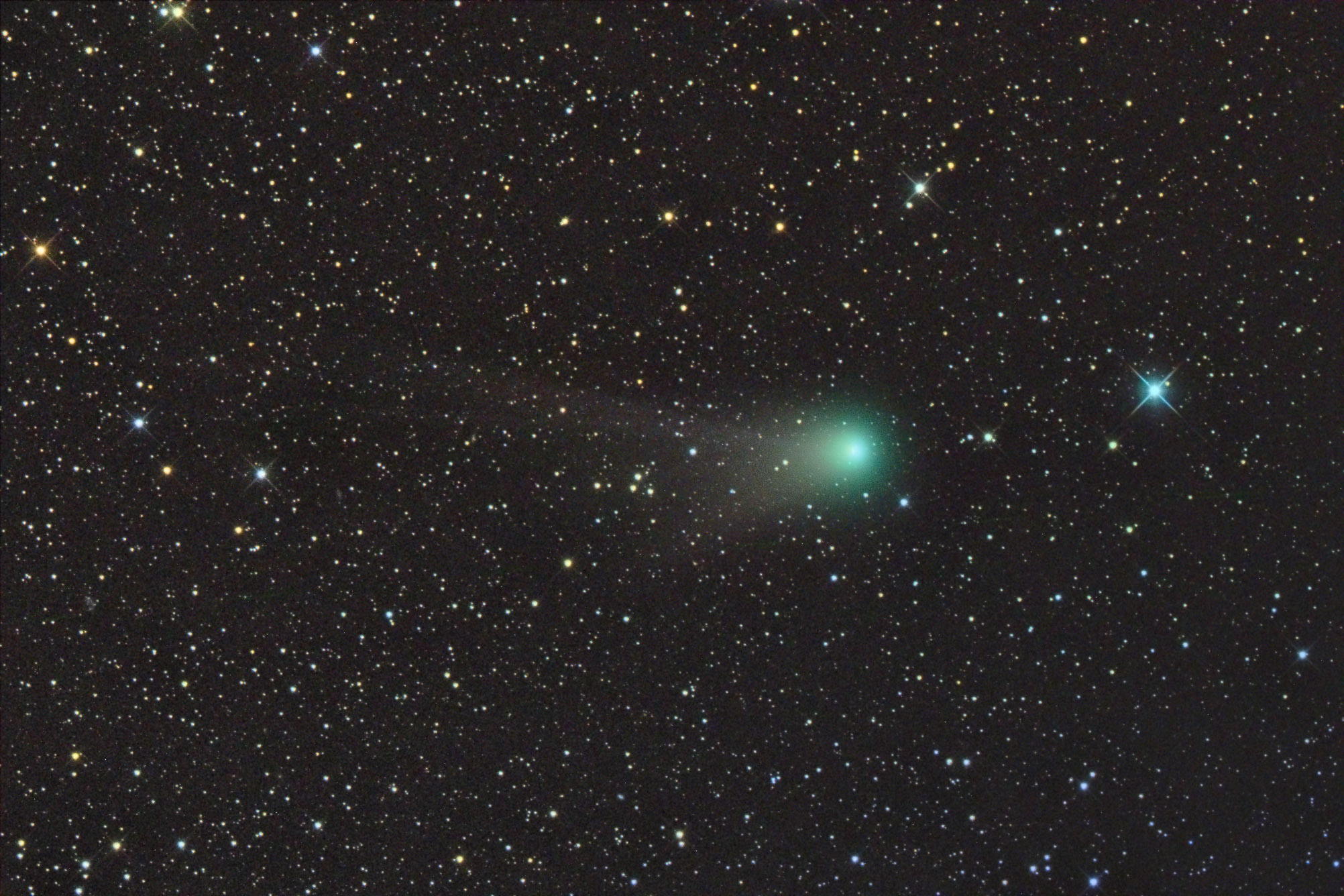
Tails of Comet Garradd
See Explanation.  Clicking on the picture will download
 the highest resolution version available.

With binoculars or a small telescope, the Comet Garradd, which was discovered back in 2009, will be passing through the constellation Hercules over the next few months. The comet sports several tails and has a green glow about it, so it should be interesting to observe in the nighttime sky. Additionally the comet is 2 A.U. (186,000,000 miles)away from us and is intrinsically large. Perhaps the Comet Garradd will be visible this coming stargaze Sunday night.

This article got me wondering, what are the differences between a comet and an asteroid? After doing a bit of research I have found a few of these differences. A comet is a celestial object believed to be composed primarily of frozen space dust and gases. A comet follows an orbit around a star and as it approaches a star it will melt, releasing its frozen space dust. On the other hand, a meteor does not follow an orbit. Also a meteor is not a meteor until it enters Earth's atmosphere - until then it is a meteoroid. I also found that there are other celestial objects that I did not account for until I finished reading, including  the differences between asteroids, meteors, comets, and meteorites.